

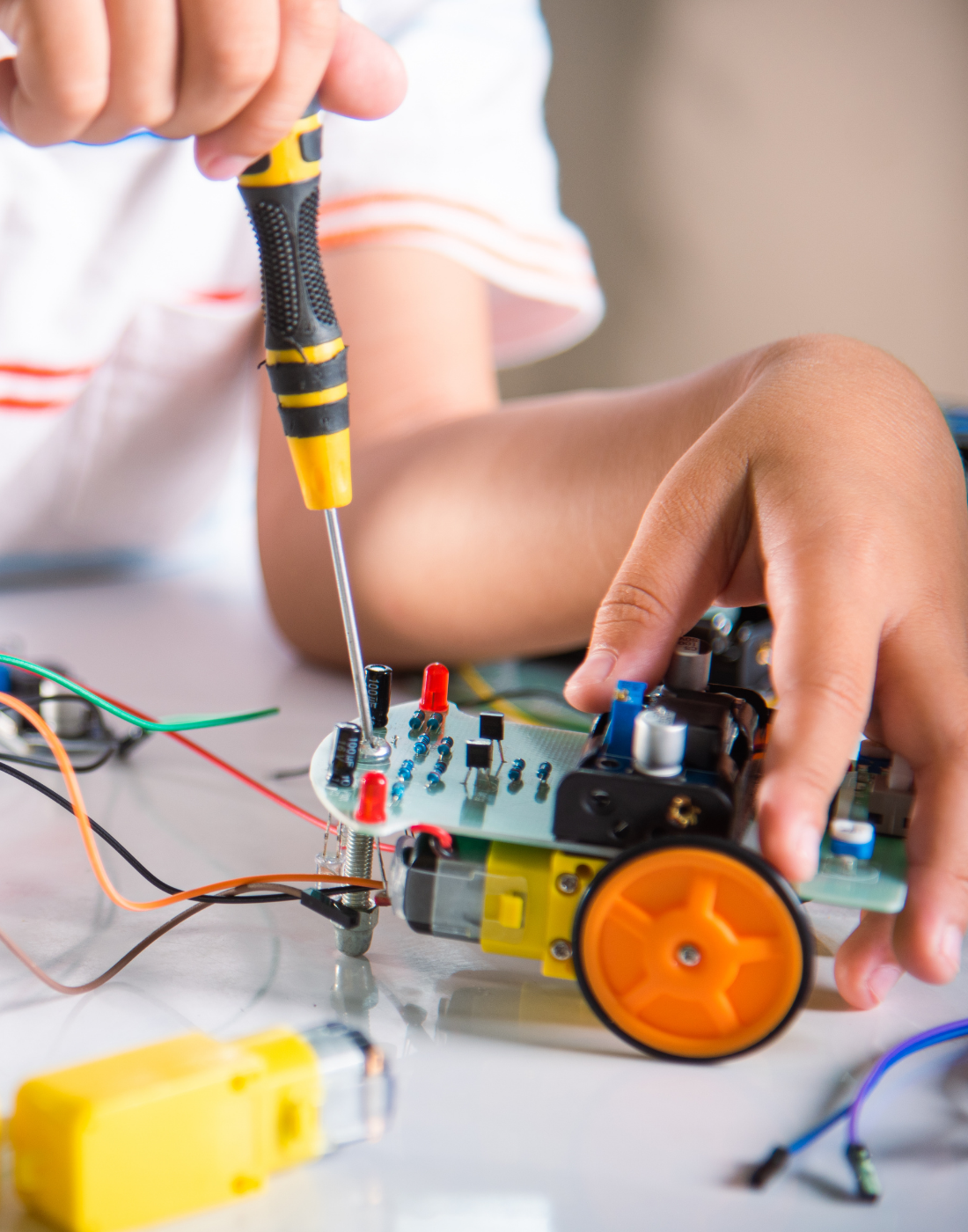

Who says you need to be in a big city to build cool tech? The talent and creativity we see in our Gumla workshops are truly inspiring. Our students are proving that with the right guidance and tools, they can build anything they set their minds to.
Here are a few of our favorite projects, all built by students right here at One Robotics Gumla!
Project 1: The Line Follower Robot
A classic starter project that teaches the fundamentals of robotics logic.
- What it is: A small, wheeled robot that uses IR sensors to detect and follow a black line drawn on a white surface.
- What Students Learned:
- Sensor Technology: How IR sensors differentiate between light (white) and dark (black).
- Conditional Logic (If-Then): Programming the robot’s “brain” (like an Arduino) to make decisions: “If the left sensor sees black, turn right.”
- Motor Control: How to control the speed and direction of two separate motors to steer the robot accurately.
Project 2: The Obstacle-Avoiding Bot
This project is where students step into the world of autonomous navigation.
- What it is: A smart robot equipped with an ultrasonic sensor (which works like bat sonar). It moves forward on its own, and when it detects an obstacle, it stops, “looks” left and right, and intelligently navigates around it.
- What Students Learned:
- Real-Time Data: Using sensors to get live feedback from the environment.
- Programming Loops & Functions: Writing more complex code to create a continuous “sense-think-act” cycle.
- Problem-Solving: Debugging why the robot might get stuck or not “see” an obstacle correctly.
Project 3: The Automated Smart Streetlight
This project shows students how robotics and automation can solve real-world problems.
- What it is: A model streetlight that uses a Light Dependent Resistor (LDR) sensor. When the room gets dark, the streetlight automatically turns on. When the light comes back, it turns itself off.
- What Students Learned:
- Analog Sensors: How an LDR’s resistance changes with light, sending a variable signal to the microcontroller.
- Automation Principles: Creating a system that runs on its own without human intervention.
- Energy Efficiency: Discussing how this simple project could save electricity on a large scale.
These projects are just the beginning. They build confidence and prove to our students that they have what it takes to build the future.
What will YOU build? and start creating!
